


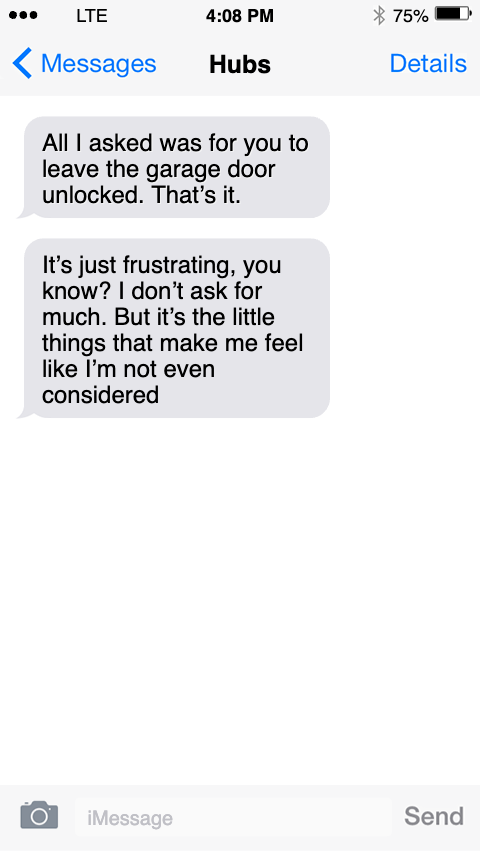
There it was. The text message that made me want to scream into a pillow:
All I asked was for you to leave the garage door unlocked. That’s it. It’s just frustrating, you know? I don’t ask for much. But it’s the little things that make me feel like I’m not even considered.
 And in that moment, I wanted to reply: You want to talk about little things?
The little things that pile up until I’m one broken shoelace away from a total meltdown? Like remembering the class costume day, making packed lunches, scheduling dentist appointments, replacing the toothpaste, restocking loo roll, finding matching socks, and being the only one who notices we’re out of bin liners?
But I didn’t reply. I just stared at the screen. Because how do you explain to your partner that your brain is already on overload before you’ve even had your morning tea?
This Is What Mental Load Looks Like (And It’s Not Pretty)
Mental load is the invisible work. It’s not the doing, it’s the thinking. The remembering. The planning, checking, and noticing. It’s what turns a calm Saturday into a chaotic checklist in my brain:
- “Do we have enough snacks for Monday?”
- “Did I RSVP to that birthday party?”
- “When did the youngest last bathe? Be honest.”
- “What am I forgetting to remember?”
And the truth? Most of it goes unnoticed. Because when it’s done right, everything looks smooth. Nobody sees the gears grinding behind the scenes.
A study in Sociological Inquiry defined mental load as the cognitive labour involved in household management, which overwhelmingly falls to women. Another study from the Bright Horizons Modern Family Index found that 86% of working mums say they handle the majority of household responsibilities. That’s not just cleaning or cooking—it’s thinking for everyone.
Marriage or Mothering? Sometimes I Can’t Tell
Sometimes, I catch myself writing reminders for my husband in the same planner I use for the kids.
“Take bin out – Tuesday night”
“Doctor’s appointment – yours, not mine”
“Call your mum back”
That’s when it hits me. I’m not just a partner, I’m project manager of the entire household. And it’s exhausting.
It’s not that my husband doesn’t help. He will do things… if I ask. But that’s the problem. I don’t want to be the foreman, delegating tasks. I want a co-pilot, someone who sees what needs doing and just… does it.
Because asking is another task. One more thing to remember. One more decision to make.
But He Feels Unappreciated Too
Let me be clear.
I know he’s not the villain in this story.
He works hard. He loves us. He’s not out partying while I’m drowning in laundry.
But when he sent that message about the garage door, it felt like being punched in the gut with a bag of wet nappies.
Because I forget one thing—one garage door—and suddenly I’m inconsiderate?
When I’ve been considering everyone else’s needs before my own for the last nine years straight?
That’s when the resentment creeps in. It doesn’t explode. It simmers. Slowly. Quietly. Until you’re sitting next to each other watching telly, feeling worlds apart.
So What Do I Wish I Could Say Out Loud?
I wish I could say…
I’m tired of being the human glue holding everything together.
I’m tired of remembering everything for everyone—and still being the one who gets called forgetful.
I wish I could say that when you send me a message like that, it lands on top of a mountain of invisible things I’ve done today. Things I didn’t announce, or ask for praise about, or even think twice about. I just did them.
I wish I could tell you that I want to feel considered too. I want someone to remember that I also get overwhelmed. That I need help before I ask. That sometimes I just want to fall apart without having to schedule it in between school pickup and dinner.
I wish I could say that I resent the fact that your one request becomes a whole conversation—but no one’s texting me about the fifteen things I pulled off to make today function.
I wish I could tell you that I see all your good intentions. But I’m drowning anyway. Not because I don’t love our family. But because it feels like loving them has made me disappear.
And I don’t want to disappear.
I want to be seen. Not just when I forget. But when I show up, day after day, holding it all together with sheer force of will and half a reheated coffee.
What Happened After That Message?
When my husband came home I told them that I wanted to talk about the text he sent. With his arm crossed he sat down on one end of the couch. I stood in the kitchen for a second too long, wondering if I was really going to say what I needed to say without softening it with a joke or wrapping it in a compliment sandwich.
And then I did. I said, “Do you really think I don’t consider you? That I don’t see you? Because I feel like I’m carrying every single invisible thing that keeps this family from crumbling, and the one time I forget a door, I get called out like I don’t care.”
His expression softened. He didn’t jump in to defend himself like he sometimes does. He just listened. And I cried—not because I was angry, but because I was tired. Bone-tired.
He apologised. I apologised. Not because either of us were wrong, but because neither of us had really seen the other.
That night, we made a pact to try again. To stop pretending like it’s all fine. To communicate like teammates instead of flatmates. To stop saying “just tell me what to do” and start actually noticing.
Now, we try to:
- Have a Sunday night check-in: We sit down for 10 minutes and go over what’s coming up. Dentist appointments. School events. Food shopping. He picks two things he’ll handle start to finish.
- Use a shared calendar: Google Calendar is now the keeper of our sanity. Colour-coded chaos, but shared chaos.
- Let things drop: If the kids forget their library books or I don’t RSVP in time for a party—oh well. Nobody dies. Nobody cries. The world keeps spinning.
- Say thank you: Even for silly things. Even when it’s stuff we’re “supposed” to do. Because gratitude is free and resentment is expensive.
- It’s not perfect. But it’s better. And sometimes, that’s enough.
If You’re Nodding Along, You’re Not Alone
If you’re reading this and thinking, “YES. THIS. EXACTLY THIS,” then I want to tell you something I wish someone had said to me sooner:
You are not crazy. You are not broken. You are not unloving or overdramatic or too much.
You’re just a person who has carried too much for too long, in silence.
You’ve answered questions no one else thought to ask. You’ve planned meals, managed moods, remembered birthdays and appointments and that the dog needs his heartworm meds. You’ve done it all so well that they forgot it was ever work to begin with.
And now you’re tired. But you’re still standing.
I see you. All of you. The you who cries in the bathroom and wipes her tears before the kids see. The you who shrinks her needs because “it’s just easier that way.” The you who read this far because something deep in your chest whispered, finally, someone gets it.
So let this be your sign: you are not invisible. You are not alone. And it’s okay to want more from your marriage than survival and logistics.
It’s okay to want joy.
It’s okay to want help without having to ask for it.
It’s okay to want to be seen—not for what you do, but for who you are.
Speak your truth. Even if your voice trembles. Even if it starts with a whisper. Even if it starts with a text about the garage door.
Because the mental load doesn’t have to be yours alone.